
Pruning
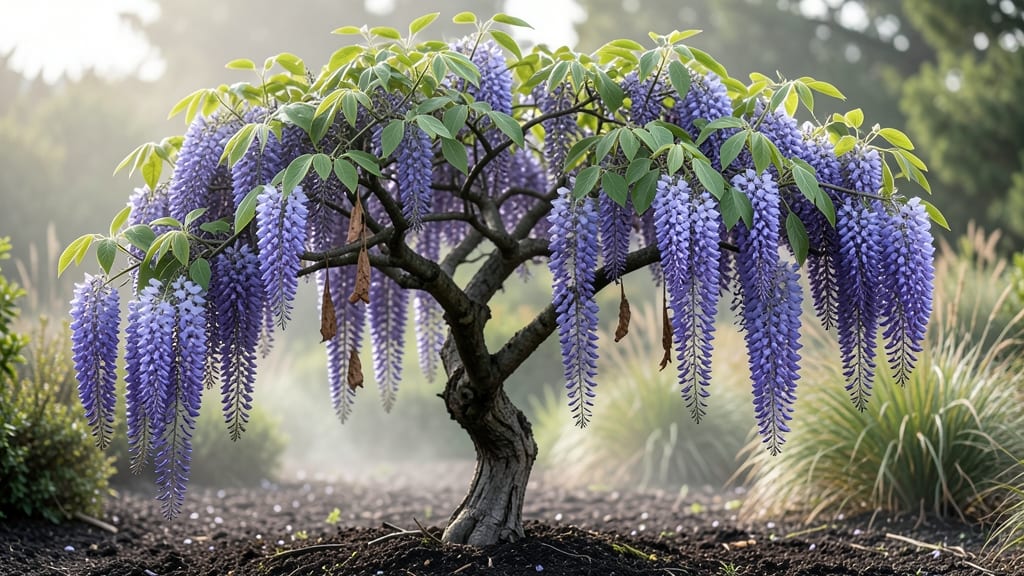
Transforming Amethyst Falls wisteria into a stunning tree form is one of those gardening projects that rewards patience with breathtaking results. 🌿 The secret lies in guiding its vigorous vines into a single, strong trunk while encouraging a lush canopy—something I perfected after my first wisteria nearly took over the fence.
This variety’s deep purple blooms and fragrant clusters make the effort worth every snip of the pruners.
The foundation starts with the right rootstock and soil—well-draining, slightly acidic mix enriched with compost. Plant in full sun where it gets at least 6 hours of direct light daily, and stake the central leader early to prevent flopping.
Pruning begins in late winter before buds swell, removing all but one strong central stem and thinning out competing suckers to shape that iconic tree silhouette.
By summer, you’ll see the payoff: a strong trunk supporting cascades of fragrant blooms instead of tangled vines. Regular pruning keeps the form tight and encourages more flowers, while mulching protects roots from heat stress.
The key is consistency—skip a year, and the vines will take over the structure you’ve worked so hard to create.
Common challenges like weak trunks or overgrowth happen when pruning is too aggressive or neglected. Train new growth along the trunk each year, and never let more than one main stem develop.
With this approach, your Amethyst Falls wisteria will become the showstopper of your landscape—every spring, summer, and even fall when the foliage turns golden.
📚 In This Guide
- What you need
- Instructions
- Tips and common mistakes
- Wrapping up and next steps
What you need
- ● Pruning shears: Sharp, bypass-style shears (for small to medium stems)
- ● Loppers: 6–8" loppers (for thicker branches, up to 2" diameter)
- ● Pruning saw: Curved-tooth pruning saw (for stubborn, thick branches)
- ● Disinfectant (70% isopropyl alcohol or bleach solution): 1 part bleach to 9 parts water (to sterilize tools between cuts)
- ● Rubbing alcohol or hand sanitizer: For cleaning hands before and after pruning
- ● Garden gloves: Heavy-duty, cut-resistant gloves (to protect from thorns and sap)
- ● Tarp or drop cloth: Large enough to catch debris (4’x6’ or larger)
- ○ Twine or zip ties: For securing branches during training (optional but helpful)
- ● Stakes and soft ties: 3–4 stakes (for temporary support if needed)
- ● Pruning sealant: (For large cuts over ½" diameter—controversial but some swear by it!)
- ● Tree form pruning kit: Includes a central leader support pole and spreaders
- ● Ladder or step stool: For hard-to-reach branches (ensure it’s stable!)
- ● Camera or phone: To document progress before/after pruning
- ● Compost bin: For collecting pruned branches (great for mulch or compost)
Step-by-step pruning guide for Amethyst Falls wisteria tree form
Transform your wisteria into a stunning tree form with these simple yet powerful techniques.
🌿 Step 1: Identify and Prepare for the Pruning Season
Wisteria thrives with late winter or early spring pruning, just before new growth begins. The ideal time is when you see buds swelling but before leaves emerge. This timing ensures you're cutting back dormant wood while preserving next season's blooms.
Gather your tools: clean, sharp pruning shears for small branches and a pruning saw for thicker stems. I always disinfect my tools with rubbing alcohol between cuts to prevent spreading disease. Wear gloves—wisteria thorns are no joke!
Here's the thing—Amethyst Falls wisteria grows aggressively, so plan to spend 30-60 minutes on each mature plant. Start by mapping out your tree form. You'll want a single central trunk with 3-5 main scaffold branches spaced 12-18 inches apart vertically.
✂️ Step 2: Create the Central Trunk and Main Branches
Begin by selecting your central trunk—the strongest, straightest stem. Remove all competing vertical growth from this trunk, cutting back to the ground if needed. This ensures all energy flows upward into your main structure.
For your scaffold branches, look for sturdy stems emerging at 45-degree angles from the trunk. These should be 1/3 to 1/2 the diameter of your central trunk. Prune back any branches that are too thin—they won't support the weight of future blooms.
Make your cuts just above an outward-facing bud. The rule is: "Cut above, leave below." This ensures new growth emerges in the direction you want. For Amethyst Falls, you'll want branches that spread outward to create that classic tree form canopy.
🌱 Step 3: Thin and Shape the Canopy
Now focus on the interior of your tree form. Remove any crossing branches that rub together—this creates wounds where disease can enter. Also eliminate branches growing straight up from the scaffold limbs, as they'll compete with your desired outward growth.
For Amethyst Falls, aim to maintain an open center. You want sunlight to penetrate to the center of your tree form, which encourages blooming along the branches. Thin out about 30% of the total branches to achieve this airy structure.
Watch for "water sprouts"—those fast-growing vertical shoots that appear along the trunk or branches. These are energy vampires. Cut them back immediately to the point of origin. You'll see new, stronger lateral branches emerge within weeks.
☀️ Step 4: Summer Maintenance for Long-Term Health
After the initial pruning, your Amethyst Falls will need summer care to maintain its shape. Throughout the growing season, remove any suckers that emerge from the base of the plant. These compete with your tree form for nutrients.
In midsummer, you can do a light shaping prune. Trim back any branches that have grown too long or crowded the center. Make these cuts just above a leaf node to encourage bushier growth. This is also when you'll notice if your tree form is developing properly—you should see new blooms forming along the scaffold branches.
Real talk: Don't over-prune in summer. You're just doing light touch-ups now. The heavy work was done in winter. Too much summer pruning stresses the plant and can reduce next year's flowers. Think of it as a haircut—not a haircut and a shave!
Tips & tricks for perfect Amethyst Falls wisteria tree form
These simple yet powerful techniques will help you transform your wisteria into a stunning tree form that lasts for years.
Timing is Everything: The 30-60 minute window for each plant might seem long, but it's crucial for Amethyst Falls wisteria. Work in stages if needed—focus on one section at a time to maintain precision. I like to start with the central trunk first, then move to scaffold branches. This systematic approach prevents overwhelm and ensures you don't miss any critical cuts. The key is patience—rushing leads to uneven shapes and missed buds.
Bud Direction Matters: When making cuts in Step 2, always look for outward-facing buds. These are your growth guides for creating that beautiful canopy. If you're unsure which way a bud faces, imagine drawing a line from the bud to the branch tip—this is where new growth will emerge. For Amethyst Falls, you want branches that spread outward like a classic tree form, not upward or inward. This outward growth creates the perfect structure for those cascading blooms.
Thinning Strategy: The 30% thinning recommendation in Step 3 might feel aggressive, but trust me—it's what creates that airy, open center. Start by removing the most obvious offenders: crossing branches, inward-growing limbs, and water sprouts. These cuts might seem drastic, but they redirect the plant's energy to stronger, healthier branches. After your first round, step back and evaluate—you should be able to see sunlight reaching the center of your tree form.
Summer Maintenance Secret: During summer shaping prunes, focus on encouraging bushier growth by cutting just above leaf nodes. This simple technique stimulates lateral branching, which is exactly what you want for a full, lush tree form. I've found that making these cuts in midsummer gives you the best results—you'll notice new blooms forming along those scaffold branches by next spring. Just remember: less is more in summer, and always prioritize maintaining the open center you created during winter pruning.
Pro Tips for Amethyst Falls Wisteria Tree Form
- These simple yet powerful techniques will help you transform your wisteria into a stunning tree form that lasts for years.
- Timing is Everything: The 30-60 minute window for each plant might seem long, but it's crucial for Amethyst Falls wisteria.
- Bud Direction Matters: When making cuts in Step 2, always look for outward-facing buds.
Frequently asked questions
about the Amethyst Falls wisteria tree form can help you navigate pruning with confidence. Here are answers to common queries:When is the best time to prune Amethyst Falls wisteria?
The ideal time to prune this tree form is late winter or early spring (February–March), before new growth begins. This ensures you remove dead wood while preserving next year’s blooms. Avoid pruning after flowering—it can reduce next season’s flowers! For light shaping, summer pruning is okay, but avoid heavy cuts.
How do I encourage more blooms on my Amethyst Falls wisteria?
To maximize flowers, prune old wood (last year’s growth) in late winter—this is where blooms form. Avoid cutting back new green shoots, as they won’t flower until the following year. Thin out crowded branches for better airflow, and fertilize in early spring with a balanced, phosphorus-rich formula to support blooming.
Can I grow Amethyst Falls wisteria in a container?
Yes! This tree form adapts well to containers, making it perfect for patios or small yards. Use a large pot (at least 20 gallons) with drainage holes and a well-draining soil mix. Prune regularly to control size, and repot every 2–3 years. Just remember: container-grown wisteria may need more frequent watering and winter protection in cold climates.
Why isn’t my Amethyst Falls wisteria flowering?
Common reasons include over-pruning new growth (cut only old wood for blooms), poor sunlight (needs 6+ hours daily), or nutrient deficiencies. Check for thin, leggy growth—this signals a need for more light or balanced fertilizer. If the plant is young (<3 years), be patient: wisteria often takes time to mature and flower.
How do I control the aggressive growth of Amethyst Falls wisteria?
Wisteria is naturally vigorous, but pruning 30–50% of last year’s growth annually keeps it manageable. Use support structures (trellises, arbors) to guide vines and prevent sprawl. For tree forms, prune to open the center and remove suckers at the base. Root pruning (trenching around roots in early spring) can also curb overgrowth.
Still stumped? Tag @AmethystFallsWisteria on social media—gardeners love sharing tips for this stunning variety!
Wrapping up and next steps
Transforming your Amethyst Falls wisteria into a stunning tree form is a rewarding project that enhances both beauty and longevity!
With the right tools, timing, and techniques—like strategic pruning and patient training—you’ll create a breathtaking focal point in your garden. Don’t let perfection hold you back: start small, stay consistent, and enjoy the journey!
Ready to take the next step? Mark your calendar for late winter or early spring—when your wisteria is still dormant—and grab those pruners! For extra guidance, sketch a simple pruning plan or consult a local horticulturist to tailor the approach to your climate. Your future purple paradise awaits! 🌸✂️